

Five Wallets, One Big Squeeze

Latest
ELI Reports

Five Wallets, One Big Squeeze
Consumer sentiment ended May at 44.8, the lowest in the 74-year history of the University of Michigan index. Gas prices in California exceeded $6 per gallon. White-collar layoffs in 2026 surpassed 150,000. By all macro measures, this is the quarter many expect American consumers to finally pull back. But they won't.
In November 2025, Sooth predicted in this report — contrary to expectations — that financially anxious Americans would spend more, not less. U.S. holiday spending reached $1 trillion for the first time. Our confidence then, and now, is based on the fact that anxiety does not uniformly suppress spending. Instead, it concentrates it. The squeezed American consumer doesn't disappear; she carefully chooses what to keep, delay, or splurge on.
In May, Sooth analyzed 35.5 million financially anxious middle-income Americans and identified five behavioral coping modes: Squirrels, Hummingbirds, Owls, Wolves, and Bears. Each mode represents a different strategy for handling financial pressure. The second half of 2026 will test these instincts through two major spending periods: Q3’s travel and upgrade season, and Q4’s holiday shopping surge, which determines the year's retail performance.
Each of these five groups will allocate their spending differently, favoring different businesses. Collectively, they point to which retail, tech, travel, and finance categories will outperform — and which will face their toughest Q4 since 2020.
In The Frame
$1T U.S. holiday spending in 2025, the first trillion-dollar holiday on record.
$1.3T U.S. credit card debt at its 2025 holiday peak — an all-time high.
44.8 University of Michigan consumer sentiment score, the lowest in the 74-year history of the study.
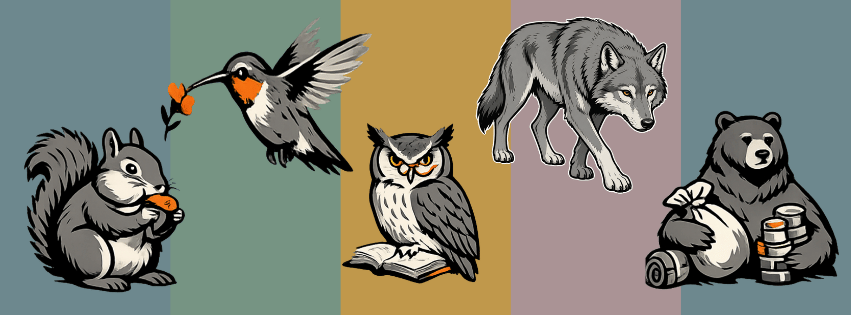
Squirrels 53% STASH | SORT | SPLURGE
Pragmatic family protectors
Buys gifts at Macy's, Kohl's, and JCPenney; leans on Dollar Tree for essentials
Cuts tech first, deferring upgrades to trade-in and refurbished
Prioritizes one true vacation, a cruise or resort stay, over several small trips
Gives mainstream, to the American Red Cross and St. Jude
Hummingbirds 20% FLIT | DREAM | SPEND
Aspirational improvisers
Splurges on beauty at Sephora and Ulta; buys fewer, nicer gifts for others
Will finance rather than skip memorable experiences like Disney parks or
cruises
Prioritizes gaming hardware as a tech win/win for the kids and themselves
Leans on pay-over- time and fintech over traditional banking and credit
Owls 13% WATCH | RESET | GIVE
Methodical repositioners
Rebalances investments before year-end, treating Q4 as a planning
deadline
Supports values- driven causes like World Central Kitchen, not big- name charities
Travels with intention, choosing national parks over resorts
Researches major purchases instead of impulse-buying at the holidays
Wolves 8% HUNT | BET | SCORE
Risk-tolerant speculators
Refuses to miss out on the latest entertainment and gaming releases
Funds splurges from trading and crypto wins, timed to NFL season and market runs
Flies budget to destinations that matter, treating airfare as a means not the experience
Will deprioritize charitable giving to keep money working for themselves
Bears 5% STOCK | PREP | SUPPORT
Bulk-buying hedgers
Stocks up at Costco, toys included, the strongest holiday shopping signal of all cohorts
Takes long road trips, choosing national parks and rentals over hotels
Buys premium tech regardless, treating quality as worth the squeeze
Givers and planners, who support their favorite charities at year end and then shift into
How America’s five financial coping strategies will impact business in the second half of 2026
1. WAREHOUSE CLUBS AND DOLLAR STORES POST THE BIGGEST RETAIL WINS OF 2026.
When money is tight, the squeeze doesn't reduce spending — it redirects it to where a dollar goes furthest. The Squirrel stocks essentials at Walmart and Dollar Tree; the Bear buys the holiday in bulk at Costco, the single strongest signal in the data. Together, they make warehouse clubs and dollar stores the year's clearest winners: Costco, Sam's Club, BJ's, and Dollar General. Mid-tier grocery is most vulnerable to being caught in the middle: not cheap or differentiated enough to justify a special trip.
2. BEARS AND WOLVES WILL DETERMINE THE 2026 HOLIDAY TOY MARKET.
The holiday toy aisle has a single driver this year: the Bear, who buys Mattel, Hasbro, and LEGO in bulk well before December, with the Wolf adding LEGO and GameStop on the gaming side. Two small archetypes move a category far bigger than their numbers suggest. Expect Mattel, Hasbro, and LEGO to beat consensus forecasts — and the specialty toy shops that live on impulse and foot traffic to consolidate or close once the season clears.
3. GAMING CONSOLES WILL PROVE THE STRONGEST CATEGORY IN HOLIDAY TECH SALES.
The upgrade everyone's waiting on in Q4 isn't a phone — it's a console. The Wolf buys gaming hardware more often than any other group, and the Hummingbird and Bear reinforce this as gifting. Expect Sony, Microsoft, and Nintendo to outpace the smartphone makers on Q4 unit economics, with GameStop posting its first winning holiday in three years. Most likely to underwhelm with holiday sales: smartphones that lead with a yet- unrealized consumer value proposition tied to AI.
4. YEAR-END CHARITABLE GIVING SURPRISES TO THE UPSIDE, AND SHIFTS TOWARD VALUES-ALIGNED PLATFORMS.
Conventional wisdom says a record-low- sentiment year means a weak giving season. The data says the opposite. The Bear and the Owl — barely a fifth of the squeezed population — give more, and earlier, than anyone else, and they give on principle: food security and values-driven causes over generalist charities. Expect total year-end giving to beat the 2024–2025 baseline, with World Central Kitchen and EMILY's List taking share from the big-name nonprofits.
5. Q4 TRAVEL SPLITS INTO TWO LANES OF ACTIVITY.
Hummingbirds will lean on fintech and credit to finance the one big destination trip, while Bears load the family into the car for national parks and vacation rentals. Both grow despite the squeeze. Expect Disney parks, Airbnb, and value-priced airlines to outperform — Frontier especially, absorbing the ultra-low-cost demand stranded when Spirit shut down in May. The loser is the mid-tier resort and packaged vacation that fits neither the splurge nor the road trip.
About Sooth & ELI
Sooth is the predictive intelligence company decoding the 93% of human decisions driven by emotional, practical, and situational needs. Powered by ELI — Sooth's exclusive Emotional Logic Interface — Sooth uncovers hidden signals, turning audience behavior into predictive foresight. Sooth's patent-pending methodology uses artificial intelligence to cross-reference more than 100 million intent signals with data on 300 million individuals worldwide to predict buyer tendencies with 91% predictive accuracy. For more information, visit: soothbetold.com.
In addition, the following sources were used for corroborating data and the qualification of predictive insights:
35.5M financially anxious middle-income Americans, five behavioral coping modes: Sooth ELI platform, May 2026 - Consumer sentiment 44.8, lowest in the index's 74-year history: University of Michigan Surveys of Consumers, May 2026 - California gas above $6/gallon: AAA, 2026 - White-collar layoffs surpass 150,000 in 2026: Challenger, Gray & Christmas, 2026 - U.S. holiday spending tops $1 trillion: National Retail Foundation, 2025 - U.S. credit car debt hit a record $1.28T at the 2025 holiday peak: Federal Reserve Bank of New York Household Debt and Credit Report, Q4 2025
Subscribe to the ELI Report
Enjoyed these insights? Subscribe now and get actionable tips delivered to your inbox every other week—giving you an edge over your competitors.


.jpg)