

Sports viewership in the streaming era

Latest
ELI Reports

Sports viewership in the streaming era
American sports fandom is systematically fragmenting: not the passion for the games themselves, but how people watch them. Live broadcasts, once a common cultural touchstone, are now split across numerous streamers, each with its own cost structure. Watching every 2026 Yankees game on television costs $1,487 and requires 10 separate networks and apps. Fans’ frustration, as well as their budgets, have reached a breaking point. As sports podcaster Errol Marks put it recently, the state of fragmented sports streaming has reached “absolute ridiculousness.”
By every conventional measure, a market this fractured and this expensive should be shedding fans. It isn't. The fragmentation is sorting, rather than shrinking the audience. Depending on their needs, different fans triage in different ways: keeping what matters, cutting the rest. Those choices are a story to watch closely in the coming years.
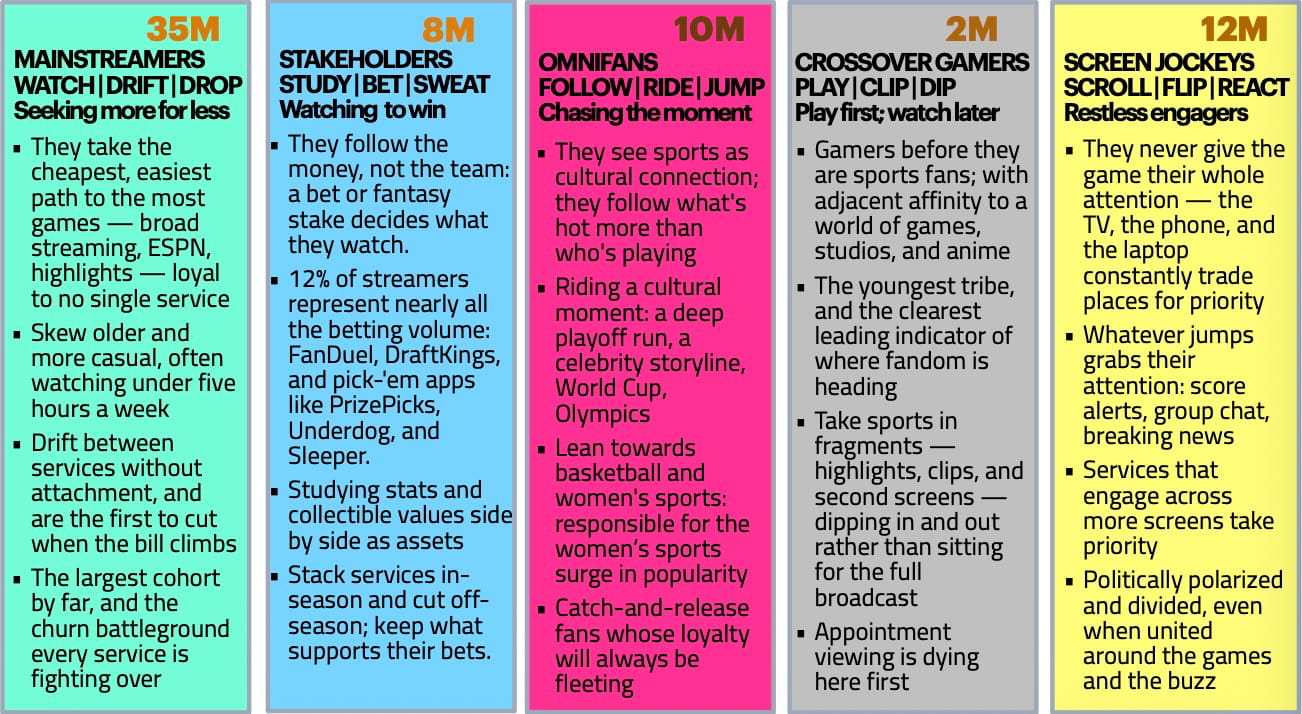
Sooth analyzed America’s 67 million sports fans who stream live sports weekly and found they divide more by their lifestyle adjacencies than by allegiance to any team, network, service, or device. Five behavioral tribes emerged; each will curate subscriptions by a different logic, but all showed clear re-aggregation patterns anchored by sports betting, multi-screen engagement, and cultural integration that may have more leverage in the economic futures of the platforms, networks, and leagues than any fan faction.
In The Frame
$1,487 - What a cable subscriber will pay to watch every Yankee game in 2026
67M - US viewers who regularly stream live sports
3.6 - Average number of streaming sports apps being juggled by US sport viewers
The Five Sports Viewing Tribes Changing the Landscape
ELI's Crystal Ball 5 Predictions
How the fractured sports audience will reshape streaming, betting, and fandom through 2026 and beyond
1. ESPN FINDS NEW LIFE AS THE ANCHOR SUBSCRIPTION OF THE STREAMING SPORTS FAN.
The regional sports network is finished — FanDuel Sports Network wound down in April, stranding dozens of NBA, NHL, and MLB teams. That vacuum has one obvious filler. Expect ESPN's new $29.99 app to end 2026 as the one subscription almost every serious fan keeps, while the standalone regional network never comes back.
2. AMID SPORTS-BETTING BACKLASH, THE LEAGUES ALIGN CLOSER WITH PREDICTION MARKETS.
During the 2026 World Cup, prediction markets like Kalshi and Polymarket made up about a quarter of all legal U.S. sports-betting volume, up from less than a tenth earlier that year, and gained most betting-app downloads. Leagues like MLS and Liga MX partnered with Polymarket, and these markets attracted first-time and female bettors who had never used traditional sportsbooks. Prediction markets are expected to be the fastest-growing sports betting force in 2026, regulated, harder for states to control, and integrated into broadcasts. Stakeholders follow the action as it shifts from sportsbooks to markets.
3. SPORTS VIEWERSHIP STARTS TO SPIKE AROUND BIG MOMENTS INSTEAD OF BIG GAMES.
The 2026 World Cup just beat the NBA Finals and the World Series on U.S. television. Expect the year's largest audiences to keep coming from moments rather than seasons — the World Cup, a WNBA breaking records on a deal worth 6.5x its last — as Omnifans flood in and back out. The loser is the mid-tier regular-season game nobody's posting about.
4. FRACTIONAL VIEWING GROWS AS FULL-GAME STREAMING SLIPS AMONG FANS UNDER 35.
Young fans meet sports through highlights now, not full broadcasts, and a majority already watch them on YouTube every month. Expect linear ratings among 18–34s to fall again while the leagues keep treating YouTube and TikTok as promotion, not primary rights. The clip is winning the fan; the broadcast still holds the rights — and that standoff won't break in 2026.
5. BUNDLING SPORTS WITH NEWS AND ENTERTAINMENT DELIVERS SHORT-TERM WINS AND LONG-TERM LOSSES FOR PLATFORMS.
Folding sports into a big content bundle looks like a winner up front: more to watch, more reasons to subscribe, a quick lift in sign-ups. But sports draws the widest audience in media precisely because everyone watches it, across every divide. The other content in the bundle doesn't play as neutral, and over time it chips away at the one audience sports had kept whole. Expect the bundle math to pay off in 2026 sign-ups and quietly cost platforms later — as the very breadth that won the subscriber starts sorting the audience the game had unified.
Subscribe to the ELI Report
Enjoyed these insights? Subscribe now and get actionable tips delivered to your inbox every other week—giving you an edge over your competitors.


.jpg)