Five Types of Shoppers Reveal How Americans Buy

Latest
ELI Reports

Five Types of Shoppers Reveal How Americans Buy
More than half of American shoppers say they don't have a favorite magazine, sports league or even a brand in everyday categories. That doesn't mean they've stopped watching, shopping, or spending. Nine in 10 stream content and shop Walmart, Target and Aldi at roughly the same rate as everyone else. What's disappearing isn't consumer activity. It's consumer preference.
Sooth analyzed 21.6 million primary household shoppers who buy online weekly. The breakdown didn't sort them by what they preferred, but by whether they expressed a preference at all.
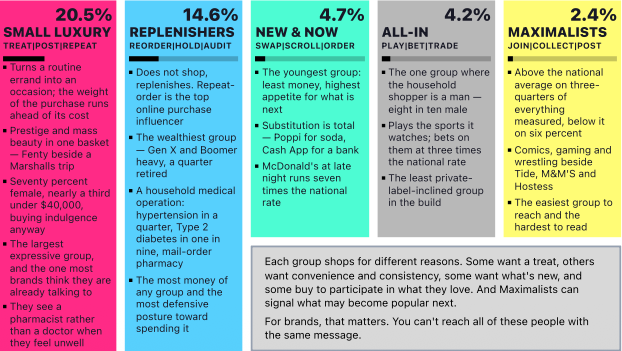
The split is close to even. The non-expressive majority accounts for 53.6% of the category. The other 46.4% divides into five shopper types: people who turn errands into experiences, households that routinely reorder the same things, younger shoppers who choose alternatives to established brands, men who buy what connects them to the sports they follow, and a small group of 2.4% who express interest in almost everything.
That last group is four times more likely than average to say it is interested in almost anything — too small to sell to on its own, but often an early signal of what the larger groups pick up next. Together the five are what brands can most clearly identify today.
THE FIVE SHOPPER TYPES
Sized by share of the population studied — the bars, not the cards, carry the weight.
ELI'S CRYSTAL BALL 5 PREDICTIONS
How targeting, private label and the beauty ladder change when the largest group in the category stops expressing preference
1. THE MAJORITY IS RECLASSIFIED FROM LOW-VALUE TO UNREACHABLE, AND THE MEASUREMENT BREAKS BEFORE THE STRATEGY DOES. Media models built on expressed affinity are optimizing against 46% of the category and reporting it as the whole. Promotional depth has the same problem in reverse: the least couon-responsive group in the build is also the largest, so the discounts land on the people least moved by them. Expect the reckoning as a measurement problem rather than a strategy memo — reach curves that stop reconciling, incrementality tests flat on the biggest audience a brand has. The blind spots are specific as well as large: in the All-In group eight in ten shoppers are men, a position category planning does not describe.
2 PRIVATE LABEL DOES NOT GIVE BACK SHARE WHEN NATIONAL BRANDS CUT PRICE. Store brands reached a record 23.8% of U.S. grocery unit sales in the first half of 2026 while their dollar sales stayed flat and national brand dollars rose 2.2%. The standard read is that shoppers traded down under pressure and will trade back when it eases. Inside the majority group, that is not what happened. Store brands run high there because the branded alternative never entered the consideration set in the first place. Deflation does not rebuild a consideration set. That share is structural now, and the price-led win-back campaigns being planned for 2027 will underdeliver against forecast.
3 THE BEAUTY LADDER COLLAPSES INTO ONE BASKET, AND OFF-PRICE IS WHERE IT SETTLES. In the largest expressive group in the category, prestige and mass beauty are not tiers a shopper graduates between. They are two things in the same trip, bought by someone who may be earning under $40,000 and buying the indulgence anyway. Portfolio strategies that force a choice between tiers will lose her, and brands reading the aspiration as permission to premiumize will lose the trip entirely. Watch off-price, not the department store, for where the basket lands.
4 FOOD AND PHARMACY BECOME A SINGLE DECISION FOR THE CATEGORY'S MOST AFFLUENT SHOPPERS, AND AUTO-REPLENISHMENT FINDS ITS REAL AUDIENCE IN THE OLD. The Replenishers run a household medical operation alongside the grocery order, and belong to loyalty schemes at the highest rate of any group in the study. Brands still treating the basket and the medicine cabinet as separate purchases are competing for half a decision. The second half is the more expensive mistake: auto-replenishment models are almost all built for young digital natives,while the receptive audience here is older, asset-holding, and already reordering without being asked.
5 INCUMBENCY BECOMES A LIABILITY IN THE YOUNGEST GROUP, AND THE SMALLEST GROUP IS WHERE ITSHOWS UP FIRST. In New & Now the substitution away from legacy brands is category-wide and simultaneous — soda, beauty, banking and apparel all at once — which points to one shared cause rather than four separate competitive failures. The challengers winning there solved a hard problem: they sell aspiration in small denominations to a shopper with almost no disposable income. Expect that to keep working, and expect brands that price up to the aspiration to lose her entirely. The 2.4% Maximalist group is the early read on all of it, with more headroom for licensing and collaboration than anywhere else in the category — a read-ahead group for New & Now rather than a market in itself.